



- 03 Aug, 2026
- 3 Mins Read
10 Years of ABSL Reports: The Soft Skills Poland’s Business Services Sector Keeps Coming Back To
For more than a decade, Accent Business Training has stood just offstage of the ABSL Summit. Through our Preparing Speakers coaching program, we prepare the speakers who take that stage—helping business services leaders turn technical expertise into confident, compelling presentations in front of hundreds of their peers. That decade of cooperation with ABSL gave us a front-row seat to something we wanted to put a number on: which soft skills does the sector actually keep asking for, year after year?
So we read all ten of ABSL’s annual Business Services Sector in Poland reports, from 2017 through 2026, and pulled out every mention of skills, competencies, and talent priorities. The pattern is clear, and it’ just what you would expect.
The Short Answer
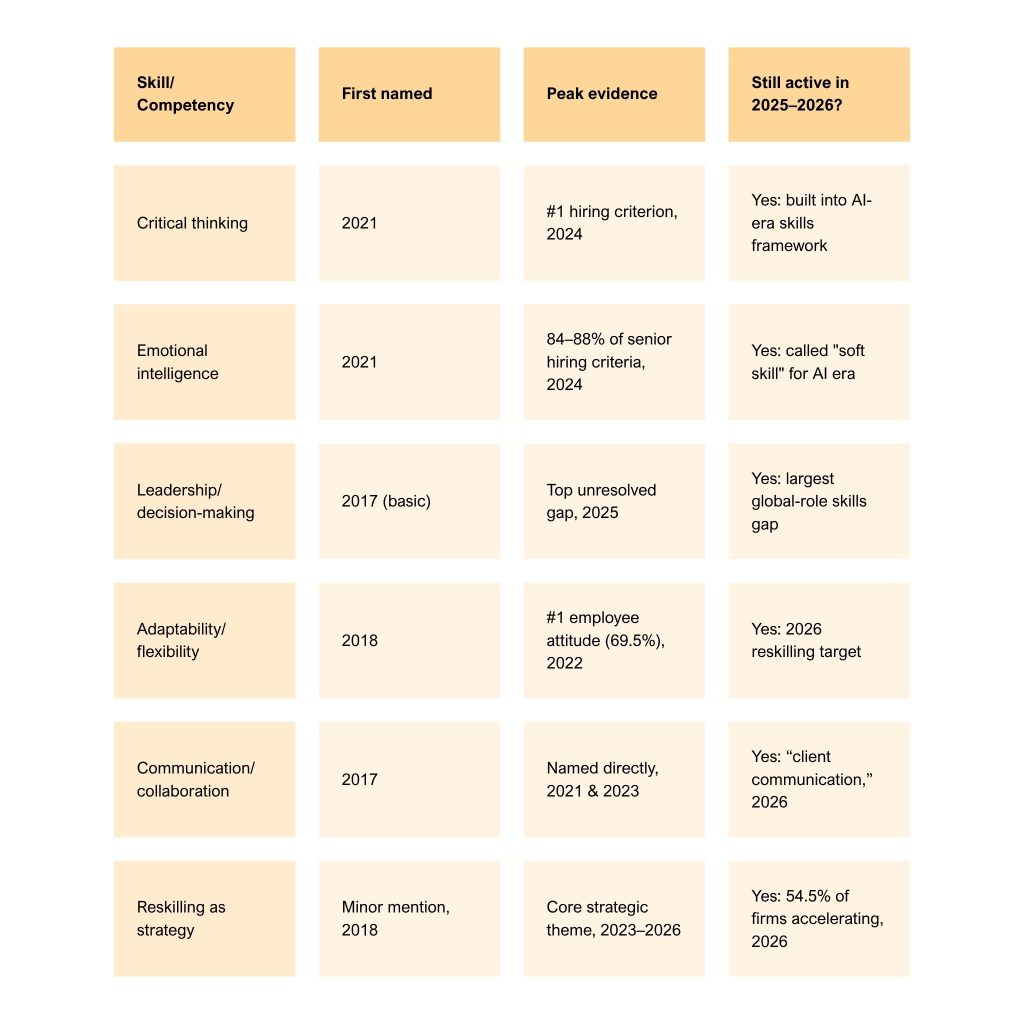
Poland’s business services sector has spent a decade moving from a language-and-cost advantage to a capability-and-cognition advantage. Language skills and technical know-how still matter, but the competencies that show up most consistently—and rank highest—across ten years of employer surveys are: critical thinking, emotional intelligence, leadership, adaptability, and communication. In the most recent editions, these are no longer framed as “nice to have”—organizations explicitly fund them as reskilling priorities alongside AI training.
What a Decade of Data Actually Shows
- Critical thinking and emotional intelligence are the most durable
These two competencies first appear by name in the 2021 report and, by 2024, become the top hiring criteria for both junior and senior roles in the sector—ranked ahead of technical qualifications (ABSL 2024, pp 199–202). By 2025, they’re formally written into the sector’s “skills for the AI era” framework, positioned as the human counterweight to automation (ABSL 2025, pg 124).

- Leadership is the gap that isn’t closing
Back in 2022, leadership ranked #3 (at 43.9%) among competencies that would be needed by 2027 (ABSL 2022, pg 164). By 2025, ABSL’s own data shows “leadership is not keeping pace,” with open-mindedness and creative thinking, cited by 62.7% of respondents as the top leadership barrier, and strategic decision-making, which was named by 46.1% as the main gap preventing Poland-based professionals from reaching global roles (ABSL 2025, pp 110–111). Ten years in, leadership development is still the sector’s unfinished business.
- Flexibility and adaptability survive every rebrand
Named as “agile ways of working” in 2018, flexibility and adaptability ranked as the #1 desired employee attitude in 2022 at 69.5% (ABSL 2022, pp 16–17, 160), paired with emotional intelligence in the 2025 “soft skills” category, and reappearing in 2026 as one of the reskilling targets (ABSL 2026, pp 139–141)—adaptability is the one skill every framing change keeps.
- The talent shortage never disappears—it just changes shape
Every single year names a talent constraint. But by 2026, ABSL describes the shift precisely: the sector is moving “from scarcity to skills mismatch,” with location decisions now prioritizing “skill mix and expertise over cost alone” (ABSL 2026, pg 111). The problem of talent shortage was never solved—it was redefined by focusing on location.
- Companies are funding soft skills as AI’s necessary complement
This is the clearest shift in the newest reports. The 2025 report states plainly: “companies need to focus on technical and soft skills to truly harness AI’s potential… adaptability, emotional intelligence, and creativity will allow employees to work alongside AI effectively” (ABSL 2025, pg 124, 128). By 2026, this is measurable: reskilling budgets are already split between hard AI skills (prompt engineering, data analytics) and soft skills (client communication, problem-solving, adaptability) (ABSL 2026, pp 129, 139–141).
Why This Matters If You Lead People in the Sector
If your organization is still budgeting soft skills training as a “nice-to-have” (or a “first to cut”) line item, the data says otherwise: 90% of Polish employers are already moving toward skills-based hiring (ABSL 2025, pp 131–132), and reskilling programs are being budgeted with soft skills built in from day one, not added afterward.
This is exactly the gap Accent Business Training exists to close. For over 16 years, we’ve trained more than 1,300 business professionals a year—80% of them from the shared services sector. And we focus on the exact competencies this decade of ABSL reports keeps mentioning: critical thinking, emotional intelligence, leadership, and communication under pressure.
Written by John Held